24.11.2026
When the smallest distances, vibrations or changes in position have to be detected under demanding environmental conditions, eddy current sensors are often the first choice. They are used in many areas of industrial automation, such as position and motion control, machine tools and production systems, test bench construction, and process and quality monitoring.
eddy current sensors from eddylab GmbH
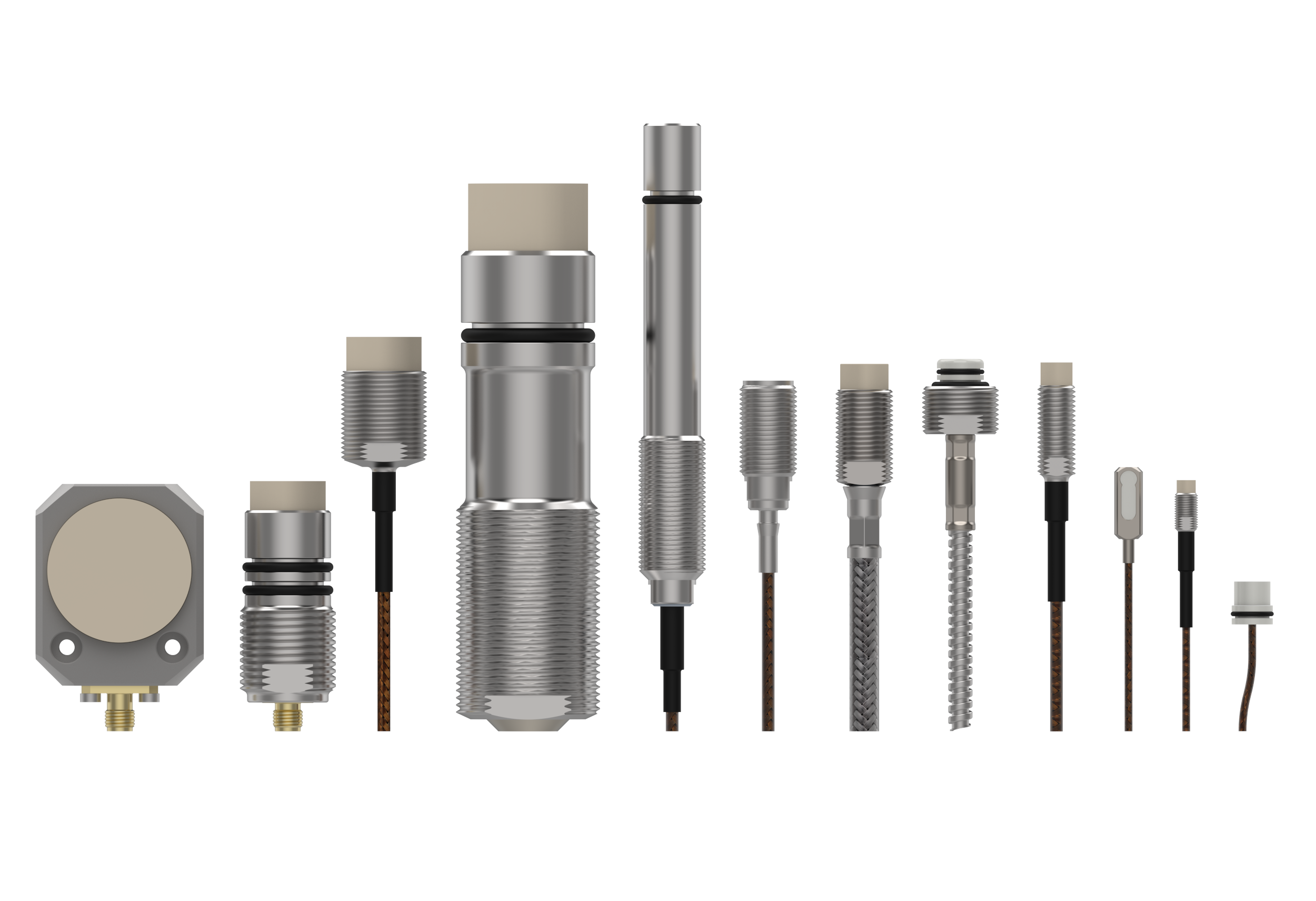
With a wide range of product series, eddylab offers a comprehensive portfolio for almost every industrial measurement task. The various series are designed specifically for different requirements in terms of measuring range, temperature, installation space and environmental conditions. What all systems have in common is non-contact, wear-free and high-precision measurement on metallic objects.
Eddy current sensors are ideally suited for use in rough industrial environments because, owing to their physical measuring principle, they are not affected by non-conductive media such as water, dust, dirt, coolant or oil between the sensor and the target.
As standard, the sensors can be used in a temperature range from -60 °C to 185 °C. Thanks to their optimized temperature coefficient, thermal influences such as fluctuations in ambient temperature have hardly any effect on measuring accuracy.
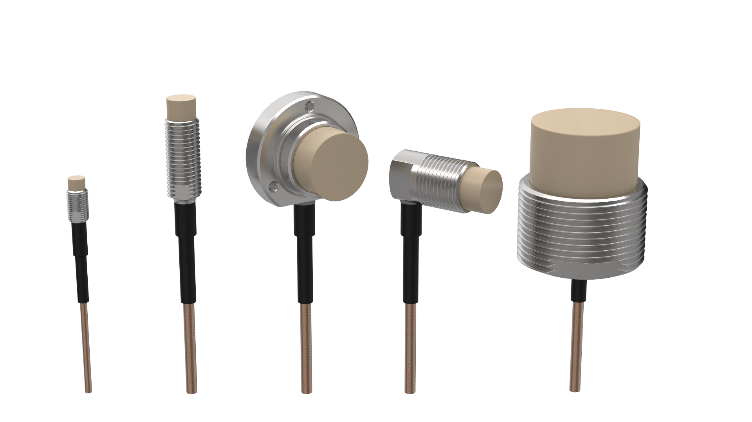 The T Series stands for high-precision, high-dynamic measurements with measuring ranges from 0.5 to 12 mm and offers a wide variety of designs. With a resolution of up to 0.03 µm, high dynamics and an operating temperature between -60 and 185 °C, the robust sensors are suitable for demanding applications in industry and laboratories.
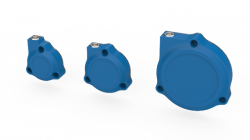
For long measuring ranges, the T14, T20 and T40 series are available. The sensors offer measuring ranges up to 45 mm and feature an extremely flat design. This makes them ideal for vibration measurements with larger amplitudes.
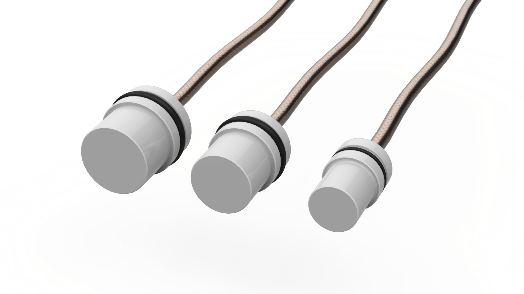 The small ceramic sensors of the CM Series were developed for applications with minimal installation space. The all-ceramic design enables use in demanding applications under high pressure (up to 100 bar) and at temperatures up to 185 °C. Thanks to their compact dimensions, the CM Series is particularly suitable for confined installation situations with measuring ranges
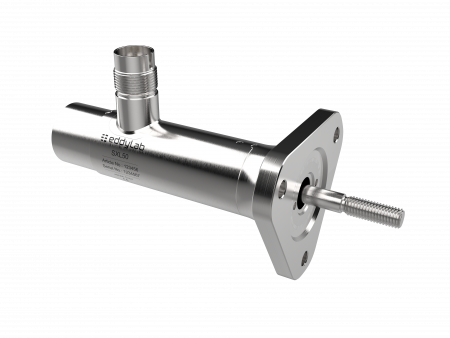
For heavy-duty applications in particularly harsh environmental conditions, eddylab offers the CT Series with protection class IP68/69K.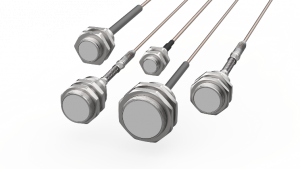 The sensors are ferrite-shielded and are therefore unaffected by the surrounding material, so flush mounting is possible. The CT sensors are designed for high operating temperatures up to 200 °C and Series CT - for extremely harsh conditions feature a special pressure-tight encapsulation of the ceramic sensor element as well as of the cable outlet. As a result, the sensors can be installed completely, including the rear cable connection, in the pressure area or operated permanently submerged in the medium. Thanks to the use of zirconium oxide, the front of the CT sensors withstands a pressure of up to 220 bar.
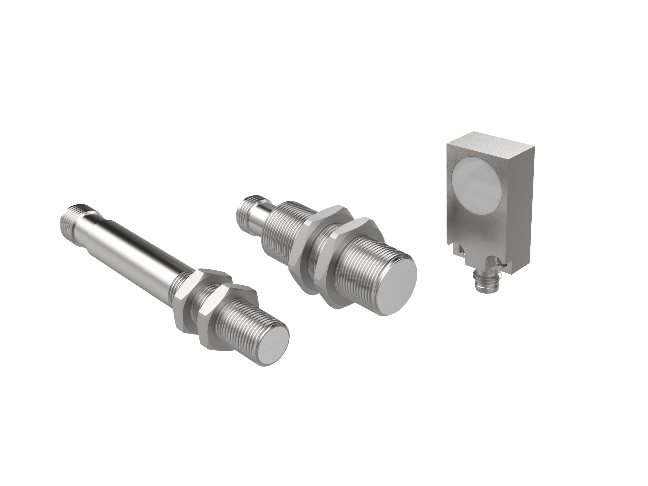
The portfolio is rounded off by the IC Series, characterized by integrated signal conditioning. designs enable precise measurements. A teach-in function allows flexible adjustment of the measuring range as well as compensation for installation tolerances and material properties.
In addition to the standard product portfolio, there are hundreds of customer-specific sensor housing variants. eddylab realizes special designs in close coordination with customers – individually, easily and quickly, starting from a quantity of 1.
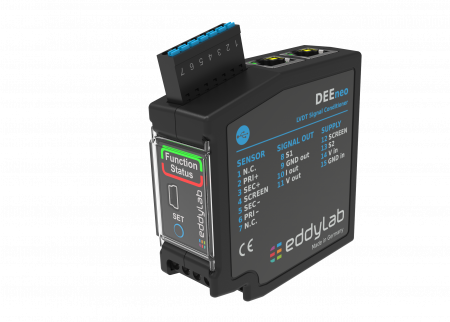
Together with the controller, the TX basic module, which is available as a 1- or 2-channel version, and the eddyMOTION software, measurement data can be analyzed, visualized and documented.
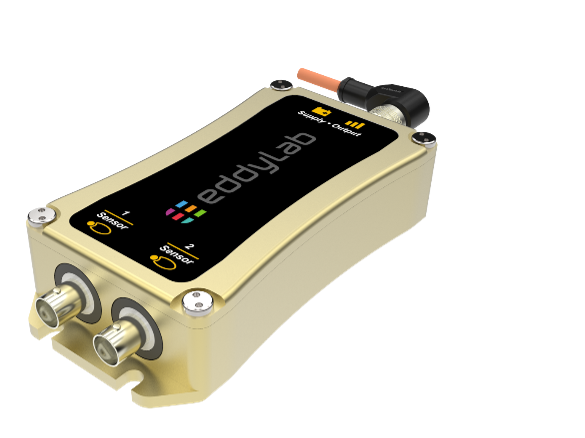 The TX electronics are the heart of eddy current measurement. Designed for maximum dynamics and precision, they convert sensor signals into measured values accurate to the micrometer. The system is complemented by the analysis and configuration software eddyMOTION, which, in addition to visualization and configuration of the sensors, also enables on-site linearization of eddy current sensors. In this way, users can specifically compensate for influences caused by material, geometry or installation and even carry out a traceable calibration themselves.
The entire measuring chain can thus be optimally adapted to the respective application and high precision ensured.
The accuracy of eddy current measurement is largely determined by the material dependent properties of the target, since the electrical conductivity and the magnetic behavior of the target considerably influence the measuring signal. For reproducible and stable measurement results, a special calibration of sensor and evaluation electronics is therefore crucial.
The eddy current measuring systems from eddylab GmbH are thoroughly tested before delivery and calibrated as a matched complete system. This gives the customer a highly accurate measuring system – depending on the sensor electronics even down to the sub µm range.
By default, calibration is carried out on steel (16MnCr5) as the reference material. In addition, we keep a large selection of further calibration materials available, including steel, stainless steel, aluminium, titanium, nickel-based alloys and brass.
 In addition to the TX electronics, eddylab offers the AX electronics, high-resolution analogue sensor electronics, also for immersion depths of up to 100 m (IP68 / 10 bar). An O-ring seal of the housing and tight LEMO triaxial connectors ensure a sealed housing concept.
Eddy current sensors from eddylab GmbH are used in numerous industrial sectors in which high-precision, non-contact measurement of displacement, position and motion is required.